March 13, 2026
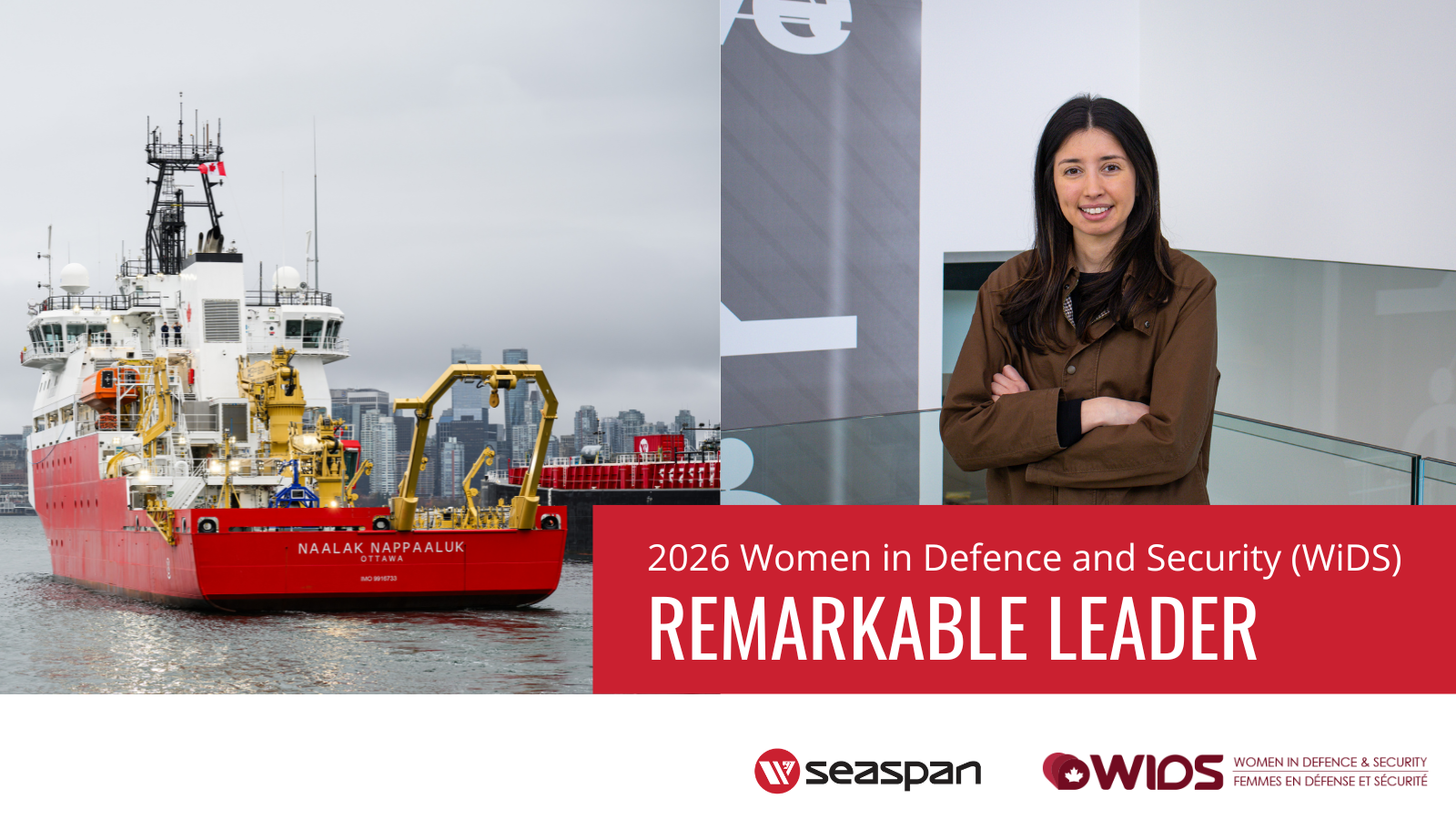
Every year, Women in Defence & Security (WiDS) celebrates and recognizes women who demonstrate leadership and inspire change through their Remarkable Leaders campaign. This year, Seaspan is proud to share that Karla Herrera, Area Manager, Polar is one of the deserving nominees.
Karla has over a decade of experience in shipbuilding, getting her start as an Intern at Vancouver Shipyards in 2016 before working her way up to her current role as Area Manager, Polar. We sat down with her to learn more about her experiences over the past ten years at Seaspan:
When did you first start at Seaspan? What was your first role?
I first joined Seaspan in 2016 as a Naval Architecture Intern for a four-month term while completing my degree. I was one of the first women to be hired as an engineering intern at Vancouver Shipyards. After graduating in May 2017, I returned for another internship with the Naval Architecture team before being hired full-time as a Requirements and Acceptance Coordinator, where I supported the verification and acceptance of ship requirements.
After about ten months, I moved to the Outfitting Engineering Department, where I spent three and a half years working on the three Offshore Fisheries Science Vessels (OFSV). In that role, I worked closely with the production team, providing engineering support to keep outfitting work moving forward.
In 2021, I transitioned fully into production and took on my current role as an Area Manager, for the Offshore Oceanographic Science Vessel (OOSV) program.
What has your favourite project been?
It is hard to pick just one because both OFSV and OOSV have been favourites for different reasons. The OFSV was my first shipbuilding project, and it was where I learned a lot about how the shipbuilding process works and how engineering and production come together in the shipyard.
Working on OOSV was very rewarding in a different way. As an Area Manager, I was directly responsible for specific areas of the ship, and it was exciting to watch those spaces evolve from bare steel into fully functional areas where people will live, cook, and work while at sea.
What changes have you seen in Vancouver Shipyards over time?
One of the biggest changes I’ve seen since I first joined Seaspan is how much the shipyard has grown, especially in terms of the number of people involved in the work. As projects have progressed and more vessels have moved through construction, the teams supporting shipbuilding have expanded significantly.
It’s also been really encouraging to see more women joining the industry. Over the years, I’ve noticed more females working across the shipyard, which has been great to see.
Shipbuilding requires a lot of collaboration across many teams, and it’s been exciting to watch both the shipyard and the people within it continue to grow.
What does your role look like day to day as an Area Manager?
As an Area Manager, my day to day role focuses on coordinating the work happening within my assigned areas of the ship to make sure it progresses safely and according to schedule.
The role also involves working closely with many different teams across the shipyard, including trades, supervisors, planners, engineers, sub-contractors and quality teams. No two days are exactly the same, and that’s part of what makes it so interesting. My goal is to support teams so they can safely and efficiently build the vessel.
What vessels are you currently supporting?
I’m currently an Area Manager for the new heavy polar icebreaker being built for the Canadian Coast Guard. My main focus will be the accommodation spaces, which include the areas where crew and personnel will live and work while onboard.
Right now, the vessel is still in the manufacturing phase, with the first machinery spaces blocks beginning to move towards ship construction. As the build progresses, my work will shift more toward coordinating and supporting the outfitting of the accommodation areas as those spaces begin to take shape.
If you had any advice to share with young women considering going into the shipbuilding industry, what would it be?
My advice would be to stay curious and not to be intimidated by the industry. There are many opportunities to learn and grow, and every role plays an important part in bringing the ships to life. Shipbuilding can be challenging, but it’s also an incredibly rewarding industry to be part of. Watching a vessel go from steel to a fully operational ship is a really unique experience, and it’s something I would encourage more women to be part of.