
Earlier this month, Seaspan Shipyards (Seaspan) celebrated the launch of a new, one-of-a-kind polar icebreaker vessel at Vancouver Shipyards. This marks the first time a polar icebreaker of this scale has been built in Canada, and it will play a critical role in inspiring the next generation of shipbuilders for decades to come.
Measuring 11 feet long and 2 feet wide, Seaspan’s new polar icebreaker is incredibly complex, designed to operate self-sufficiently in the air-conditioned climate of the Vancouver Shipyards corporate office year-round. Designed and built in North Vancouver, the vessel is constructed entirely out of Lego bricks.
In April of 2025, Seaspan celebrated the first cut of steel on the Canadian Coast Guard’s (CCG) new heavy polar icebreaker, marking a special moment in Canadian history and a step forward in protecting Canada’s sovereignty.
Simultaneously, construction on the Lego polar icebreaker was well underway.
After years of comparing the shipbuilding process to building with Lego blocks, a project was launched to do just that – to build a parallel version of the heavy polar icebreaker, made entirely out of Lego. The goal was not simply to create a display piece, but to bring the vessel to life as a model that could be used to visualize the ship, spark conversation, and inspire future shipbuilders.
As it turns out, building with Lego can be just as complex a feat as building with steel. Expanding on our Canadian supply chain, Seaspan turned to local experts Paul Hetherington and Robin Sather—Canada’s first LEGO Certified Professional. Renowned for their large-scale builds and appearances on TV shows like “LEGO Masters,” Paul and Robin were the perfect duo to bring the icebreaker to life using Lego bricks.
A collaborative effort
To get a sense of the task ahead, Paul and Robin paid a visit to Vancouver Shipyards, meeting with Seaspan’s innovation team, and even donning VR headsets to explore the 3D model of the icebreaker at the Holoship facility.
Once they understood the scale and complexity of the ship model, Robin got to work using specialized software to design the hull outline while Paul focused on the compartments. Seaspan’s engineering team also played a key role, collaborating with the builders to ensure the Lego model aligned closely with the real ship design.
Jess Fetterman, Chief Engineer on the Polar Icebreaker program, was instrumental in supporting the creation of the vessel with her team, providing details and insight into the model design.

Paul Heatherington, Lego builder, left, and Jess Fetterman, Chief Engineer, right.
“Where the Polar digital model has brought the design to life for our engineering and production teams, this Lego model shows our icebreaker’s arrangement while demonstrating how it gets lived in and worked on,” Jess said. “The Lego model is an accessible way to visualize the many technical engineer achievements in this innovative icebreaker. It’s a great conversation starter with colleagues and customers — especially because of all the fun surprises inside!”
While Seaspan’s Lego polar icebreaker may not be seaworthy, it provides a tangible way for employees and our stakeholders to understand the ship’s architecture. And for students and future members of the workforce, it is an educational entry point into the world of naval architecture, engineering and shipbuilding.
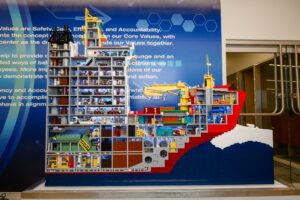
Bow section of the ship.
Building the Lego model
Much like the process of constructing an actual ship, the build involved a significant amount of planning.
The vessel was built from the bottom up, starting with Paul and Robin deciding to make each internal floor of the vessel 7 Lego bricks high, accommodating the height of the crew (Lego minifigures). This “standardized” height also determined the length of the model.
Next, Robin drafted a digital design of the outline of the hull, using a program to map out the shape of the Lego model. This informed the number of Lego bricks that needed to be ordered. Once the bricks arrived, Paul spent the next six months (totalling 520 hours) building the physical ship model — including ice and surrounding sea floor — at his home studio in North Vancouver.
Like the modular construction that takes place at Vancouver Shipyards, the model was built in six separate blocks to allow for transport. Paul built the blocks from the bottom up, with the main structure consisting of four blocks or sections, and the superstructure consisting of two sections.
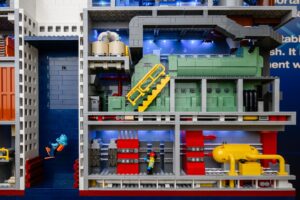
Moon pool, engine room compartment, and auxiliary rooms.
Every compartment, from the bridge to the moon pool to the engine rooms, has been thoughtfully represented. All of the elements that are key to search and rescue operations and scientific research are present, including a helicopter, lifeboats, science labs, and a crew. And if you take an even closer look, you will spot Arctic wildlife like polar bears and seals.
As far as outfitting, Paul integrated lighting during construction, with the result being an incredibly complex ship model that is 11 feet long, 4 feet tall, and 2 feet wide, built from about 152,500 Lego bricks.
Purpose and impact
The highly complex vessel is already sparking conversation and inspiration among Seaspan’s workforce. For Samantha Munroe, an apprentice welder at Vancouver Shipyards, it has been a unique chance to visualize what she is helping to build.
“It is really cool to see this representation of the vessel that I’ve been working on, and to see what I am working towards when I come in to work each day,” she said.
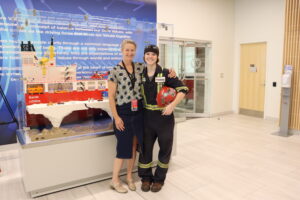
Maureen Munroe, Technical Writer and her daughter Samantha Munroe, Apprentice Welder.
Once the Lego ship model was installed, Lego shipbuilders Paul and Robin were incredibly proud to see the results of their hard work. After dedicating six months to building the vessel, Paul describes the project as having been “incredibly fun and challenging.”
“I really enjoyed doing research to try and get the colours and shapes of the machinery as accurate to the prototypes as possible. There are so many engaging scenarios happening in the model. I hope that you enjoy exploring all the details in the model and are inspired to learn more about shipbuilding and science!”
Likewise, Robin found watching the build come together to be incredibly satisfying.
“It’s always fun to design a build and then see it come together. The Polar Icebreaker model had us sculpting a hull shape, mapping out the interior, figuring out the ship’s position in the ice, and telling stories — which was great fun!”
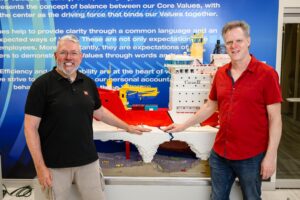
Robin Sather, left, and Paul Heatherington, right.
Now that the Lego ship is complete, Seaspan’s team of shipbuilders will continue to advance construction on the heavy Polar Icebreaker being built for the Canadian Coast Guard under Canada’s National Shipbuilding Strategy. The ship is being built to withstand harsh Arctic conditions year-round, including temperatures down to -50°C.
The Lego polar icebreaker represents the spirit of innovation, collaboration and education that drives Canada’s shipbuilding industry. Just as the heavy Polar Icebreaker will protect Canada’s sovereignty and serve future generations, its Lego counterpart is helping to inspire them — brick by brick.
