As seen in Vancouver is Awesome
After a decade in the shipbuilding industry, ship fitter Felix Yumul has seen more than four vessels built, launched and delivered at Vancouver Shipyards.
While every one of those ships, including the Offshore Oceanographic Science Vessel recently delivered to the Canadian Coast Guard, has sparked a source of pride, he says the proudest moment of his career is yet to come.
“For me, watching the polar icebreaker go into the water is going to be a career-defining moment. It’s going to be our biggest challenge yet.”
Yumul started his career working with structural steel, completing his apprenticeship as a metal fabricator before joining Seaspan. Now, he is helping build a polar icebreaker, a specialized vessel designed to navigate through thick Arctic sea ice and support year-round operations in some of Canada’s most remote waters. He says that his background in steel fabrication helped prepare him to work with the polar icebreaker’s thick, heavy steel.
The polar icebreaker being built at Seaspan in North Vancouver will be 158 m long when complete, making it the largest polar icebreaker in the Canadian Coast Guard’s fleet. It will be able to operate year-round in frigid Arctic conditions and is one of the several projects currently under construction at Seaspan.
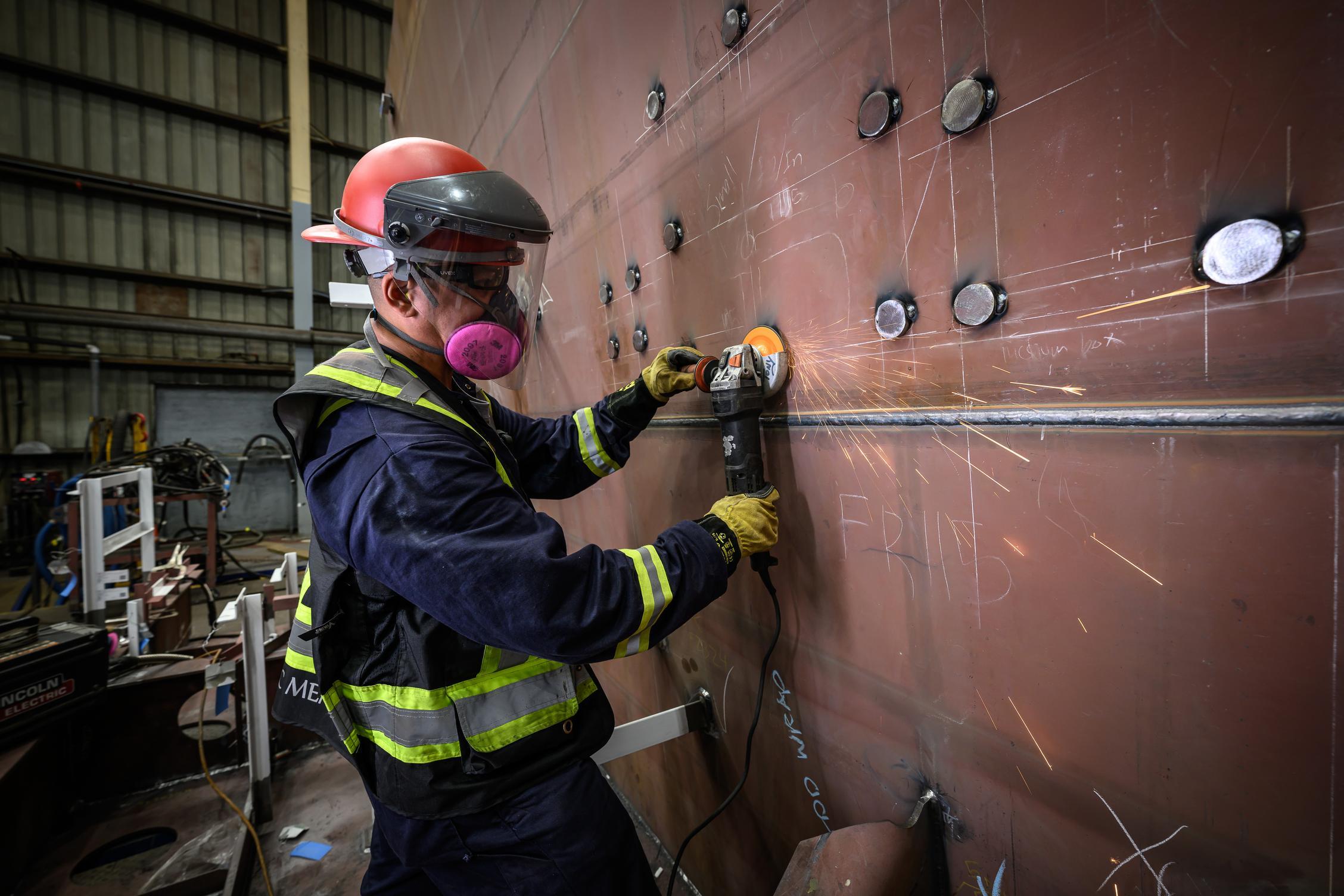
As a ship fitter, Yumul is currently working directly on the polar project, working closely with welders as part of the steel team. Fitters play an integral role in the shipbuilding process and after a safety meeting in the morning, his day-to-day tasks include bringing assemblies or parts into place, ensuring the part is level and tacking or bracing it in place in preparation for welding.
Ship fitters help put the ship together piece by piece, following ship drawings and referencing the ship model to ensure everything is in the right place. “You’ve got to really pay attention. That’s a critical part of the job,” Yumul says. “I look at the drawings carefully, especially because ship blocks are often inverted upside down. Construction is more ergonomic working down hand rather than overhead, but you need to make sure the parts go in correctly.”
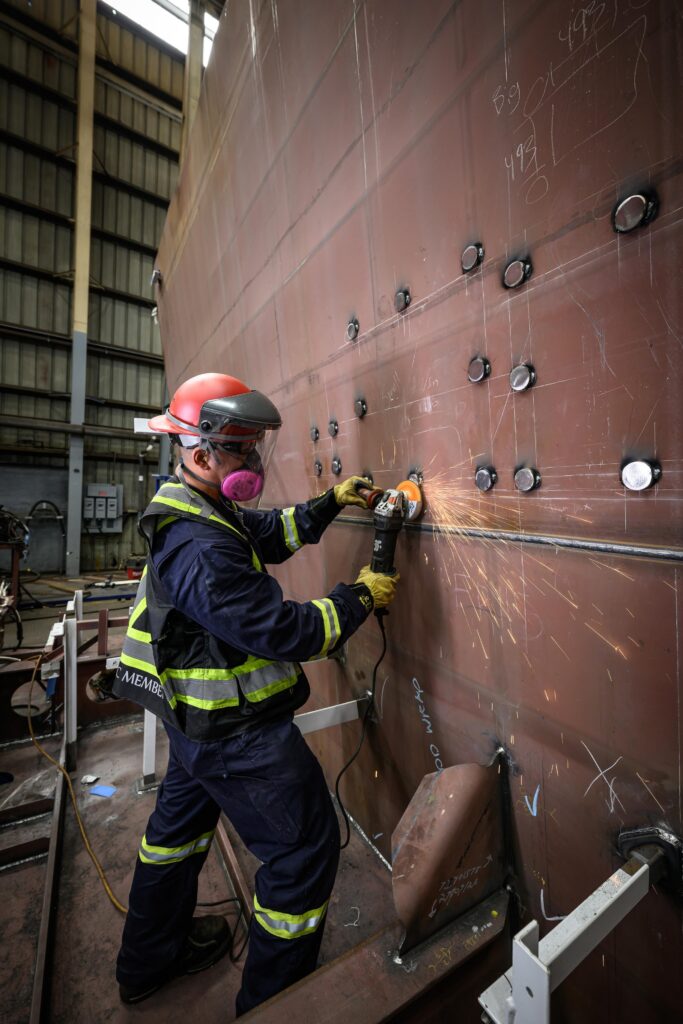
Seaspan ship fitter Felix Yumul
As a new journeyperson, Yumul was able to work at each stage of construction at Seaspan, from the start of the process in the sub-assembly shop to working on the ships.
“I’ve been able to jump around and work at each stage and across a variety of vessels which really helped give me a foundational understanding of shipbuilding. These days I’m primarily in the panel assembly shop working with polar steel,” Yumul says. “I remember moving around being really useful at the start, because shipbuilding is something you have to learn by doing.”
Yumul was also able to complete his marine fitter certification at BCIT at the start of his career at Seaspan, something that helped him gain a strong understanding of ship-specific terminology and processes after coming from outside the industry.
Yumul’s advice for incoming shipbuilders is simple: Be willing to adapt, accept constructive feedback and keep safety top of mind.
“Seaspan has a fantastic apprenticeship program here, but that’s not the only way to get your foot in the door,” Yumul says. “I had already completed my apprenticeship and received my red seal certification as a metal fabricator. So for me, it was about being adaptable to learn about the shipbuilding industry and also getting a sense of the safety culture, which is very important here.”
Since Yumul first started in 2017, there’s been a lot of change at the North Vancouver shipyard. For one, the workforce has grown significantly, from 700 employees in 2017 to more than 4,000 people coming in to work across three shifts in 2026.
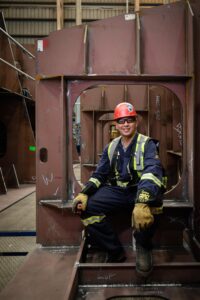
Seaspan ship fitter Felix Yumul works on the construction of Canada’s next polar icebreaker at Vancouver Shipyards.
Significant investments in infrastructure and modernization have also transformed the shipyard. These include the outfit pier, which facilitates in-water outfitting work and advancements in technology that are making shipbuilding more efficient as production ramps up on the polar icebreaker for the Canadian Coast Guard and two Joint Support Ships for the Royal Canadian Navy.
“I’d say that having access to the 3D ship model has been really useful. I can use a tablet to enter where I am and have a look at the model when I’m in the yard looking at the parts in front of me,” Yumul says. “It’s been a game changer to have that as a reference.”
With new technology and new ships being built, including a polar icebreaker that will operate in temperatures as low as -50°C, it’s safe to say that Yumul and the team working at Seaspan’s Vancouver Shipyards have some of the coolest jobs in town.