November 25, 2026
As seen in North Shore News
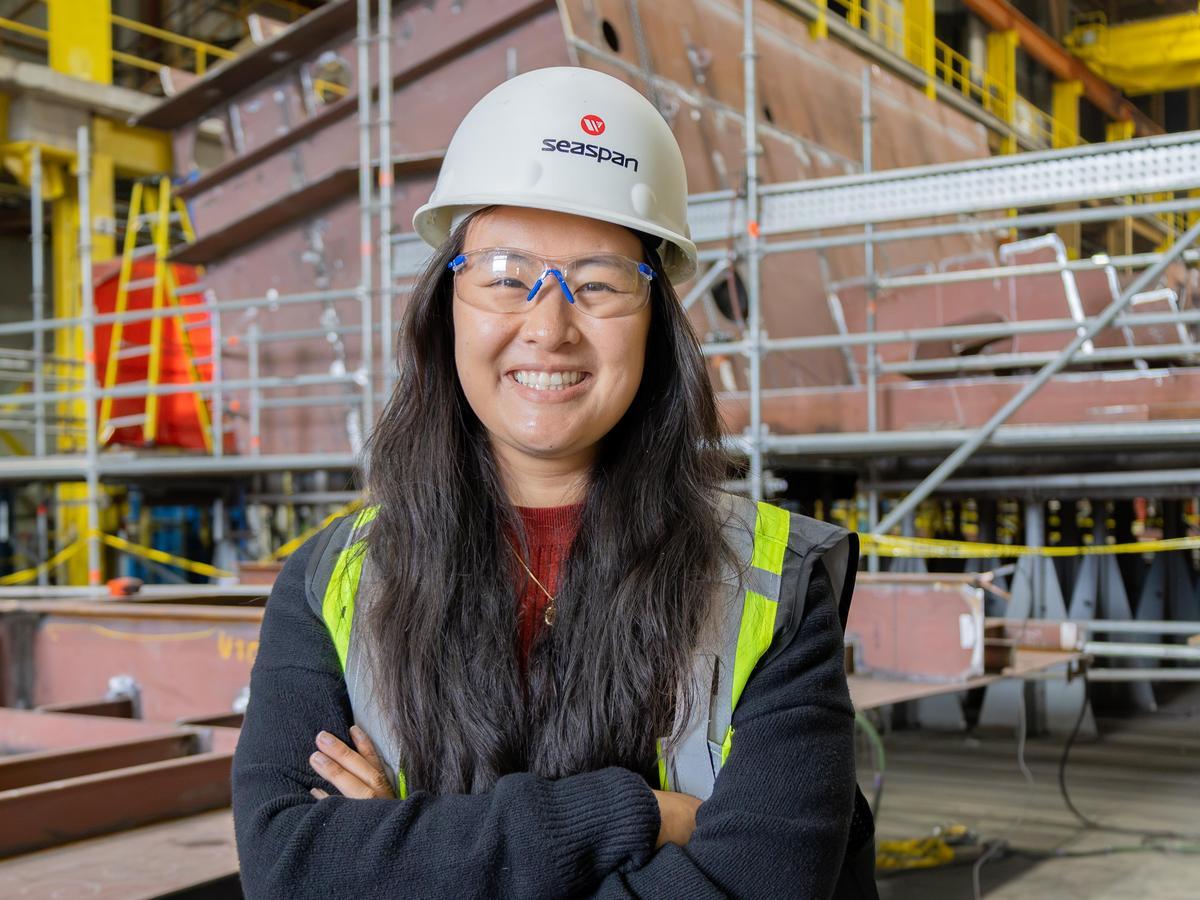
When Amanda Tuey, EIT, started at Seaspan two years ago, the career she stepped into wasn’t exactly what she had envisioned as a mechanical engineering student.
“In school, I had big dreams of working in a technical, engineering job as a designer,” she says. “But now, I’m working in a role that requires more than just a technical background.”
Today, Amanda is an assistant project manager in supply chain at Vancouver Shipyards, helping keep Canada’s largest polar icebreaker project moving forward. Before entering the shipbuilding industry, she earned a degree in mechanical engineering from the University of British Columbia (UBC), along with a minor in commerce and gained experience in the utilities and energy sectors.
When she joined Vancouver Shipyards in 2024, both Joint Support Ships being built for the Royal Canadian Navy had reached the consolidation stage, with one already in the water. In April 2025, the team marked another major milestone with the first cut of steel for the polar icebreaker, giving Tuey the opportunity to witness the project take shape from its earliest stages.
“It’s an exciting time at Seaspan,” she says. “The project has already come so far in just a year and a half. The build has been moving at an accelerated pace, which is very rewarding as we can quickly see everyone’s hard work materialize in such a visible way.”
Amanda’s primary focus is on polar icebreaker block construction, working directly with the team at Ideal Welders, a local manufacturing business in Delta. With Vancouver Shipyards’ workforce at capacity working on both the Joint Support Ships and the polar icebreaker, partnerships with local manufacturers like Ideal Welders are essential to keeping the project well underway.
Polar icebreaker block under construction at Ideal Welders in Delta, BC
The process involves Seaspan supplying Ideal Welders with cut parts and small subassemblies. Ideal Welders then manufactures the blocks and returns them to Vancouver Shipyards, where they are consolidated with other blocks being constructed on-site.
As assistant project manager, Amanda oversees the work taking place at Ideal Welders, helping ensure construction stays on schedule and within budget. Acting as a liaison between the two companies, she draws on her engineering background to troubleshoot challenges, coordinate teams and identify opportunities to improve efficiency.
Seven blocks have already been delivered from Ideal Welders to Vancouver Shipyards, with one subsequently consolidated into a larger grand block. The milestone represents meaningful progress on a project that will see Ideal Welders manufacture 30 blocks in total.
At any given time, Ideal Welders can have up to six blocks in production. Amanda helps coordinate their progress and delivery, working with both teams to address issues as they arise. If a required material or component is delayed she helps bring the right people together to find a solution.
Her engineering background has proven valuable in navigating these different responsibilities.
“If I understand the scope of an issue, I can help solve the problem and add context instead of just passing it off to someone else,” she says. “Regardless of industry, we all speak the same, foundational, engineering language.”
After two years at Seaspan, she says she is also becoming increasingly fluent in the language of shipbuilding.
For Amanda, bridging the gap between technical and non-technical teams has been one of the most rewarding aspects of the job. As she puts it, “Shipbuilding is really a team effort.”
One of her biggest surprises about the industry has been just how close-knit it is. “Yes, it’s competitive, but people share knowledge and at the end of the day, we all have the united goal of working together to make Canadian shipyards stronger.”
That shared commitment extends to building Canada’s domestic manufacturing capacity. Partnerships like the one between Seaspan and Ideal Welders help strengthen local expertise, expand regional production capabilities and support the country’s long-term sovereign shipbuilding capacity.
Amanda also hopes to encourage more young women to consider careers in engineering and shipbuilding. Although the industry has traditionally been male-dominated, she sees encouraging signs of change and emphasizes the importance of finding a supportive community.
During her time at UBC, she found value in getting involved with groups such as Women in Engineering and the Engineering Undergraduate Society. Those connections helped her build relationships and find support as she navigated a traditionally male-dominated field.
“There is a lot of support out there, but you have to actively build up that community. That’s what helps you get through,” she says. “Coming from smaller companies in the past, it’s really incredible to see that culture and pride that brings people together maintained in a much larger company. Working on the polar icebreaker, it’s really an incredible opportunity.”
Her career may have taken a different direction than the one she originally imagined, but Amanda has embraced the opportunities that have come along with that. “What you imagine yourself doing is just a starting point,” she says.