February 4, 2026
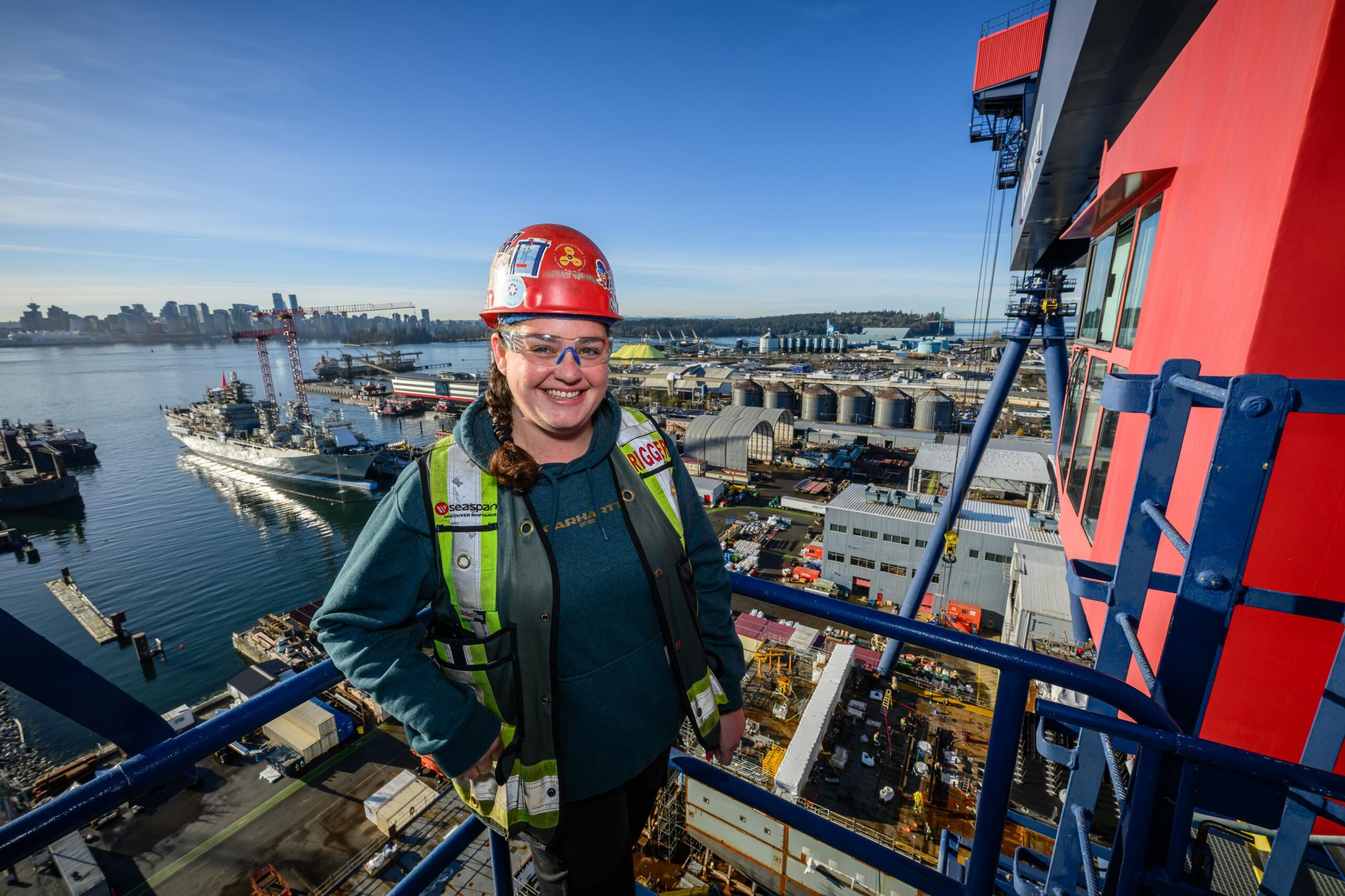
With sweeping views of the North Shore mountains and the Vancouver skyline, rigger Sarah Gould might just be the winner of the “best office view” contest.
Sarah is one of the few crane operators at Vancouver Shipyards certified to operate the iconic 80-metre-tall gantry crane, Hiyí Skwáyel, which translates to “Big Blue” in the Squamish language.
Sarah grew up on the North Shore — but she wasn’t expecting to end up in a career so close to home. She decided early on to pursue a job in the trades, following in the footsteps of her father, a fourth-generation member of the marine industry.
For Sarah, this meant making the move to Fort McMurray, Alberta. where she would go on to receive her boilermaker ticket.
“When the chance to work up north came along — and the opportunity to gain my hours quickly — I took it,” she explains. Sarah was working in a remote camp, and the 24 days on, four days off schedule was far from the typical 9-5.
Sarah made the move back to North Vancouver when she was expecting her first daughter. With few available jobs for boilermakers at the time, she switched gears and obtained her heavy-duty mechanic ticket while working for a railway.
A few years later, she got an unexpected call from Seaspan.
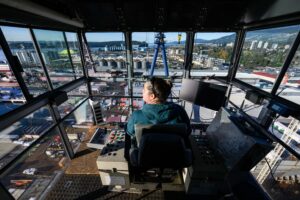
Sarah sits in the crane operator’s cabin
“It was a surprise to be sure. I had applied through the union when I first moved back but never heard anything, and now four or five years later, here I am getting this call.” Sarah said.
She was a supervisor at CN rail at the time and was uncertain about what to do next. But ultimately, it was hard to resist a job that was only five minutes away from her house, in the city she grew up in.
Sarah’s first day at Seaspan, four and a half years ago, started at night. She worked as a rigger on night shifts for almost three years before switching over to day shift.
“There is a lot of variety of work on night shift. There are fewer people in the yard and so you are doing anything that’s needed, and you pick up a lot,” she explains.
“The main difference I would say is that riggers on day shift are typically assigned to a specific crane.” In terms of how it’s affected her personal life, Sarah says she was ready for the switch back to working days.
“I learned a lot, but it’s been a total 180. I felt like I was missing a lot of time with friends and family, and being at home with my 10-year-old after work is just so nice.”
Since making the move to day shift, Sarah went from working with tower cranes and as a rigger on the ground supporting Big Blue lifts, to operating Big Blue as the first female crane operator. From her seat in the crane operator’s cabin, she can see almost all of North Vancouver.
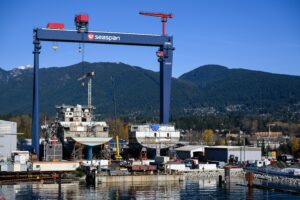
Big Blue gantry crane at Vancouver Shipyards
“Big Blue is a one-of-a-kind crane in Canada, so there was no existing certification framework for this type of equipment. Because of this, we developed a custom certification and training program, building on the overhead crane standards and expanding it to reflect the operational capacity and complexity of our goliath crane.” Jerimi Gagnon, General Supervisor, Rigging and Cranes at Vancouver Shipyards, explained.
“Safety is our top priority when it comes to operating Big Blue, and we take the training process very seriously. Throughout her training, Sarah has consistently demonstrated the skill set and commitment required to operate Big Blue safely,” Jerimi said.
In terms of requirements to operate Big Blue, you must be a journeyperson rigger, have completed the master rigger certification, work directly under Big Blue as a rigger for a minimum of 3 months, and have a crane operator ticket, all of which Sarah had.
Before Sarah was allowed to sit in the operator’s seat, she also had to write an exam, complete training with experienced operators over several weeks, and finally spend a full day operating the crane under Jerimi’s supervision, making sure to follow a rigorous safety checklist.
What sets gantry cranes apart from a standard construction crane is their ability to move forward and backwards on a fixed track. Additionally, where a tower crane can typically lift 10 to 20 tonnes (t), the massive Big Blue can lift up to 300t or 300,000 kg.
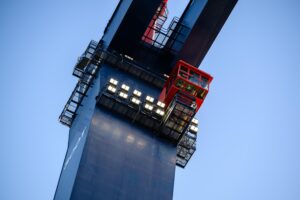
View looking up at the red crane operator’s cabin from below
This heavyweight champion is vital to shipbuilding operations at Vancouver Shipyards, where the average weight of a ship block being lifted and consolidated onto a vessel ranges from 100-200t, with heavier blocks expected for the heavy polar icebreaker currently in the early stages of construction. Big Blue is considered the largest gantry crane in North America.
“Another consideration with such a large crane is the number of blind spots,” says Sarah. “You need to always be aware while you are operating the crane. That means watching the cameras and ensuring that the tracks are clear. Sometimes you’ll realize there’s a forklift parked where it shouldn’t be or someone walking by and just not paying attention.” Sarah explains.
“I’ve learned a lot from the other operators. They’ve been great to work with, and we all have this shared sense of responsibility. The stakes are high because we need to keep our fellow workers safe from up here.”
Sarah and the other operators rely on radios and camera systems to survey and communicate with the riggers below while carrying out a lift operation. From the ground, it’s a sight to see. Ship blocks and components are lifted and sometimes turned in the air before being carefully lowered into place, ready to be welded onto the ship’s hull.
When asked what her favourite part of the role is, Sarah emphasized the importance of being able to work in North Vancouver.
“I have deep roots on the North Shore. I went to Sutherland high school and so did my mom and dad. It means a lot to me to be able to live and work here.” she said. “And, I have to admit, it’s a pretty amazing view.”
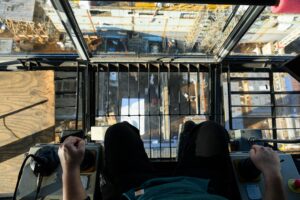
Sarah looks down onto the shipyard from the operator’s seat