When Paul Miller, a Vessel Dispatch Coordinator for Seaspan Marine, started working at Seaspan — Seaspan as we know it today did not exist. Instead, it was one of Seaspan’s predecessors, Island Tug & Barge, that first drew Paul’s attention.
“When I was a fisherman, I’d always see the Island tugboats going up and down Fitz Hugh Sound by Namu,” said Paul.
While Seaspan has a long and storied history, being officially born from a merger of Island Tug & Barge and Vancouver Tugboat Company back in 1970 — Paul was there first, beginning his own storied history, with a 55-year career that is coming to a close with his retirement this year.
That career began with Island Tug & Barge back in 1969, when Paul was looking for a new job, having previously worked both as a fisherman and at another tugboat company. It was then that a brief curiosity — sparked by those Island tugboats — turned into a lifelong journey.

The Island Ranger, one of the tugboats owned by Seaspan’s predecessor, Island Tug & Barge.
“I got on my bike; I looked and there was the sign. I went, ‘Well, I’ll try there. What the heck? I’m right here,'” he said. “They hired me, and I was on a bus heading for Victoria the next morning. I haven’t stopped since.”
When he says he hasn’t stopped since, he’s not kidding. After initially working on tugboats for what he estimated to be about 20 years, he has now settled into a dispatch role — more than five decades after taking that bus to Victoria.
Plenty has changed since then, both on the Marine side of things, and throughout Seaspan as a whole. Whether it be the acquisitions of Vancouver Drydock and Victoria Shipyards, the immense company-wide expansion spurred by the National Shipbuilding Strategy, or even the first use of the “Seaspan” name in 1970 — Paul has been here for it all. For him, one of the changes he noted was on the tugboats themselves, particularly on the new vessels, like the HaiSea fleet.

The exterior of 10 Pemberton Avenue when it was owned by Vancouver Tug Boat Company in the late 1960s, right before they would merge with Island Tug & Barge to create Seaspan.
“It’s light speed. The efficiency of those big tractors — what they can and can’t do, and the quality of the people that run them — that is what’s key,” he said. “There is no comparison. Those boats are fabulous. Once we got those tractors it was like, ‘Whoa, we’ve died and gone to heaven.’”
Yet, despite all the change within Seaspan, as Paul explained, his role within Marine is still very familiar.
“The major change is how we record it. The job itself is exactly the same. We tow barges with boats. That’s what we did. That’s what we do,” he said.
“The inputs and outputs are what’s changed. The stuff in the middle about how you record isn’t as important as what the actual job itself is. The job concerns boats, people, product and wind, weather, tide and a plethora of other things that can actually go wrong. That’s why I’m sitting here.”
Those concerns mean that sitting in a dispatcher’s chair comes with a high level of responsibility — responsibility he has grown accustomed to over the years, exercising a steady hand, even when it may not be easy.

The Seaspan King, one of the vessels Paul worked on during his time on the water.
“I have to be the voice of reason, no matter how excited or how upset I am,” said Paul. “Because when things go bad, somebody has to take control. You have to be the figure that shows the calm, that shows that: ‘Okay, I’m listening.’”
Being able to keep calm under immense pressure isn’t something that comes innately. For Paul, that skill — being able to stare down a difficult situation and instinctually come to a decision — has come about because of his vast experience, as Jessica McHaffie, the Senior Manager of Marine Personnel and Dispatch at Seaspan Marine, explained.
“All of his time at sea working on the different tugboats, all of those skills — it definitely helped him become a good dispatcher, to be able to see what’s coming next,” she said.
That isn’t the only benefit of Paul’s experience. As someone who knows the industry inside and out, Paul has been an invaluable resource to the Marine team, who can draw on his extensive knowledge.
“He’s been a steady person in the department, holding a wealth of information that he’s able to share with his coworkers and give them some different perspectives based on his in-depth experience that they otherwise wouldn’t have, including myself,” said Jessica. “Someone like Paul being on the team has been a big save for us. We’ve lost a lot of experience within the department over the last five years, so I think most of his experience is serving us well now.”

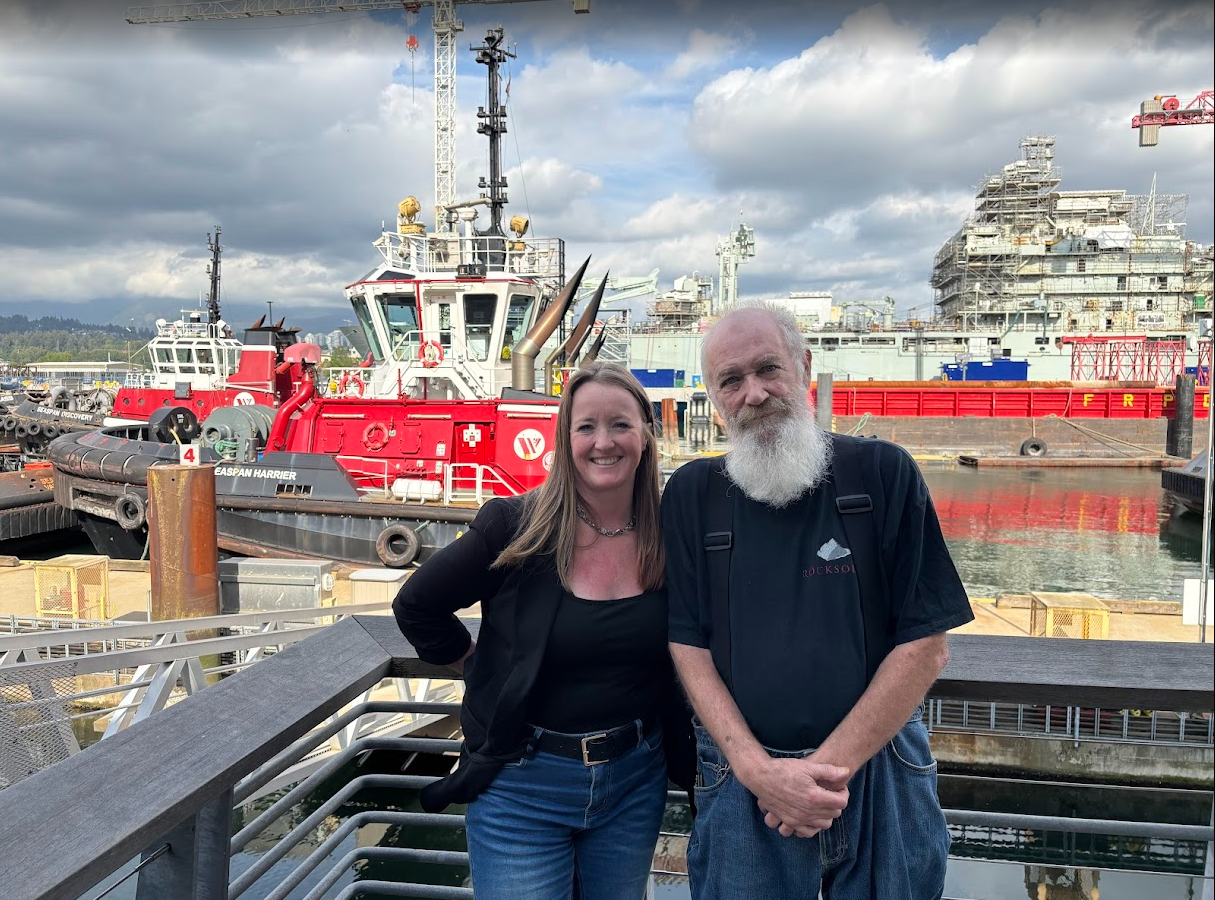
Paul Miller and Jessica McHaffie by the dock at 10 Pemberton Avenue in 2025.
Paul’s experience isn’t just useful practically. As Jessica points out, throughout Paul’s time at Seaspan, he has compiled a repository of exciting stories — all enhanced by his trademark authenticity.
“He’s himself. He’s honest. He’s not afraid to share his perspectives or experiences,” said Jessica. “We appreciate Paul, his personality, and his unfiltered commentary. I’m sure that will be missed.”
That authenticity translates beyond injecting honest humour into one of his many engaging stories. Throughout his career, Paul has been able to forge countless genuine connections with those around him, leading with an immense sense of care, kindness and respect.
“Paul is a really caring human being,” said Jessica. “He cares about those that he works with and has worked with over his career.”
While Paul clearly takes great pride in the work that he does, whether out on a tugboat, or behind the desk as a dispatcher — that work isn’t why he is still here, 55 years later.

The Seaspan Hawk and the Seaspan Falcon, both built in 1993.
“I really have made a lot of solid friendships with people on the tugs,” said Paul. “I love those guys. They’re great. That’s what’s kept me here. It’s the people. To me, that’s more valuable than anything. Money pays the bills, but it doesn’t give you heart.”
As Paul concludes his multi-decade career with Seaspan, he leaves behind a weighty legacy, with his indispensable knowledge and experience being very difficult to replace. Yet, for the young people who may have that spark of interest in the marine industry — perhaps drawn in by the image of a red-and-white Seaspan tug, just as Paul was drawn to the Island tugs 55 years earlier — having a long and successful career like Paul’s is within reach. All it takes is some determination.

Perhaps someday, a young future mariner will be inspired by Seaspan’s new HaiSea tugboats, just as Paul was inspired by the Island tugboats.
“Don’t quit. Keep going. The guy who quits doesn’t win. Especially when you’re frustrated in your training, keep going, keep going, keep going,” said Paul. “Learn from your mistakes and just keep going. Those that quit don’t make it, and those that keep pushing their nose against the wall, they’ll eventually go through the wall.”
For those who do manage to push through — to go through that wall — an incredibly rewarding career awaits, as Paul’s longevity is a testament to. It’s a career full of incredible stories, new experiences, and exceptional people, like Paul, doing immensely important work they can take pride in.
Even after 55 years, despite the company changing around him, that sense of pride is something Paul has never lost.
“It’s about safety. It’s about the building of products, providing quality services for our customers, it’s about the people that we work with, battling adversity — it is absolutely amazing,” said Paul. “I’m proud of what my team does. So, I take that home with me. ”